Chongqing’s Unique Architecture: Why This Mountain City Looks Like the Future
Chongqing’s Unique Architecture: Why This Mountain City Looks Like the Future
Chongqing’s Unique Architecture: Why This Mountain City Looks Like the Future
Exploring the Bridges, Buildings, and Urban Design That Make Chongqing One of the World’s Most Fascinating Cities
When travelers first arrive in Chongqing, many have the same reaction:
“Is this a real city or a scene from a science-fiction movie?”
The reason is easy to understand.
A subway train passes through a building.
Highways cross above other highways.
Skyscrapers stand on steep hillsides.
Buildings appear to rise directly from the mountains.
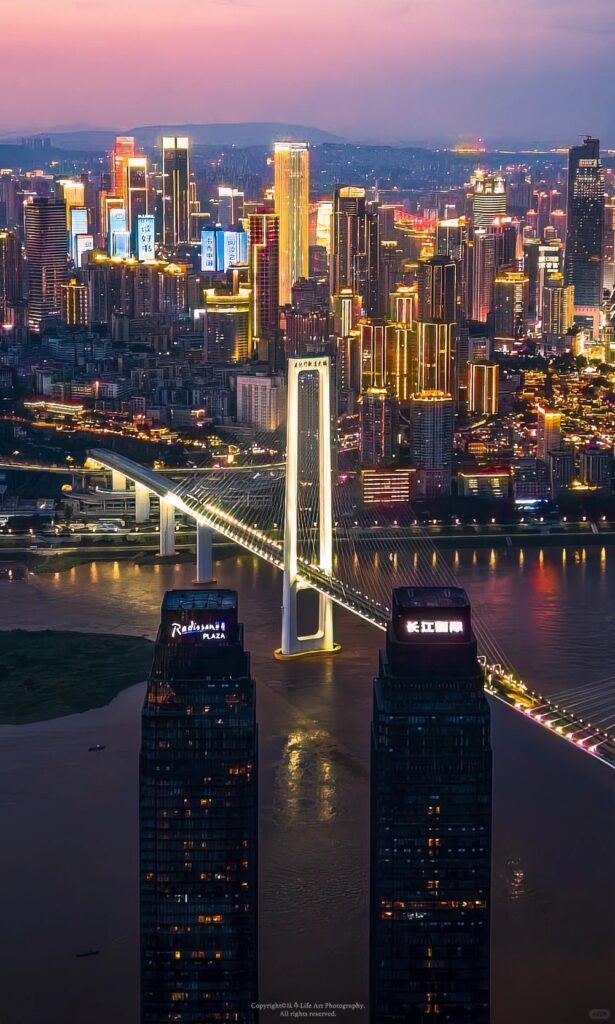
At night, thousands of lights illuminate the city, creating a futuristic skyline unlike anywhere else in the world.
But Chongqing’s unusual appearance is not simply the result of modern technology.
It is the story of how humans adapted to a challenging natural environment.
Built between mountains and rivers, Chongqing developed a unique architectural style shaped by geography, history, and local creativity.
For travelers interested in photography, architecture, urban design, or modern Chinese cities, Chongqing offers an experience unlike any other destination.
This is a city where nature creates the rules, and people find creative ways to live within them.
A City Built Between Mountains and Rivers
To understand Chongqing’s architecture, you first need to understand its geography.
Unlike many major cities built on flat land, Chongqing developed in a landscape of mountains, valleys, and rivers.
The city sits at the meeting point of the Yangtze River and Jialing River, creating a naturally dramatic environment.
For centuries, local people faced a unique challenge:
How do you build a large city when the land itself is uneven?
The answer became Chongqing’s special urban style.
Instead of flattening the landscape completely, the city adapted to it.
Buildings follow the shape of hills.
Roads climb up and down different levels.
Bridges connect separated areas.
Communities develop vertically instead of horizontally.
This is why Chongqing is often described as a “3D city.”
It is not simply a city on the ground.
It is a city built upward, downward, and across different layers.
The Famous Chongqing “3D City” Experience
For many visitors, exploring Chongqing feels different from exploring any other city.
In a normal city, you usually understand your location easily.
A street is a street.
A building has a clear entrance.
A road connects two points.
In Chongqing, things are more complicated — and much more interesting.
You may enter a building on the 10th floor and discover that you are actually standing at street level.
You may walk across a bridge and find yourself on another part of the city.
You may take an elevator from a high street down to a lower neighborhood.
This unusual design creates endless surprises for travelers.
Every corner can reveal something unexpected.
A small alley may suddenly open to a river view.
A staircase may lead to a hidden neighborhood.
A normal street may become a viewpoint overlooking the city.
Chongqing rewards people who explore on foot.
Liziba Station: Where Trains Pass Through Buildings
One of Chongqing’s most famous examples of unique urban design is Liziba Station.
For many international visitors, this scene looks impossible:
A subway train enters directly through a residential building.
But this is not a trick.
It is an example of Chongqing’s creative approach to urban planning.
Because the city has limited flat space, transportation systems often need to integrate with existing buildings and landscapes.
The subway station was designed together with the surrounding residential structure.
The result is a rare combination of transportation, architecture, and everyday life.
Every day, residents live beside the subway line while visitors come to watch the famous train scene.
It has become one of Chongqing’s most photographed locations.
More importantly, it represents the city’s ability to solve urban challenges in creative ways.
Chongqing Bridges: Connecting a Mountain City
Bridges are one of the most important parts of Chongqing’s identity.
Because the city is surrounded by rivers and divided by valleys, bridges are essential for transportation.
But in Chongqing, bridges are more than practical structures.
They have become part of the city’s beauty.
At night, many bridges are illuminated, creating spectacular views across the rivers.
Some famous examples include:
Qiansimen Bridge
Located near Hongya Cave, Qiansimen Bridge is one of the most recognizable bridges in Chongqing.
At night, the bridge lights combine with the glowing buildings of Hongya Cave to create a classic Chongqing scene.
Dongshuimen Bridge
This bridge connects different parts of the city and offers beautiful views of the river and skyline.
Chaotianmen Bridge
As one of the city’s major bridges, it represents Chongqing’s modern engineering achievements.
These bridges show how infrastructure can become art.
They are not only connecting places.
They are shaping the identity of the city.
Hongya Cave: Traditional Architecture in a Modern City
Among Chongqing’s landmarks, Hongya Cave is perhaps the most famous.
Its layered wooden-style buildings appear to climb the hillside beside the river.
At night, thousands of lights transform the area into one of China’s most beautiful urban scenes.
The design is inspired by traditional Chongqing architecture, especially the old stilt houses known as diaojiaolou.
These traditional buildings were adapted to mountain environments.
They used wooden structures and elevated designs to deal with uneven land and changing river conditions.
Hongya Cave combines this traditional idea with modern commercial spaces, restaurants, and cultural experiences.
It represents one of Chongqing’s biggest strengths:
The ability to connect the past with the future.
Mountain Roads: The Vertical Transportation System of Chongqing
In many cities, roads are mostly horizontal.
In Chongqing, roads often become vertical experiences.
Because of the mountainous landscape, the city developed a unique network of:
- Stairs
- Hillside roads
- Elevated highways
- Underground passages
- Multi-level streets
Walking through Chongqing can sometimes feel like exploring a giant urban maze.
A road may suddenly become a staircase.
A street may lead to a completely different level of the city.
A viewpoint may appear unexpectedly after climbing a hill.
For travelers, this creates a sense of adventure.
The city itself becomes an attraction.
The Relationship Between Old and New Architecture
One of the most fascinating things about Chongqing is the contrast between traditional and modern buildings.
The city contains:
Modern skyscrapers.
Historic neighborhoods.
Traditional streets.
High-tech transportation.
Old tea houses.
Luxury shopping centers.
Instead of completely replacing the past, Chongqing often allows different periods of history to exist together.
A traveler may see a modern tower behind an old neighborhood.
A traditional restaurant below a futuristic building.
A historic street beside a modern transportation system.
This mixture gives Chongqing a unique atmosphere.
It feels like a city constantly changing while still remembering its roots.
Why Chongqing Is Popular With Photographers
In recent years, Chongqing has become increasingly popular among photographers and travelers from around the world.
The reason is simple:
The city does not look like anywhere else.
Photographers are attracted by:
Dramatic Landscapes
Mountains, rivers, and buildings create natural compositions.
Unique Architecture
The city offers countless unusual perspectives.
Night Photography
The lights of bridges, rivers, and skyscrapers create stunning images.
Everyday Urban Life
Local streets provide authentic scenes of modern Chinese life.
Unlike some cities where famous landmarks are separated from daily life, Chongqing’s beauty appears everywhere.
A normal street can become a great photograph.
Why Chongqing Represents Modern China
Chongqing’s architecture tells a larger story about China’s urban development.
Over the past decades, many Chinese cities have experienced rapid growth.
New transportation systems, skyscrapers, and modern infrastructure have transformed urban life.
But Chongqing’s development has followed its own path.
The city had to solve unique challenges:
Limited space.
Difficult geography.
Growing population.
The result is an urban environment full of creativity.
Chongqing shows how cities can adapt to their surroundings instead of simply changing the landscape.
Best Places to Experience Chongqing’s Architecture
For visitors interested in urban design, these locations are highly recommended:
Hongya Cave
Best for traditional architecture and night views.
Liziba Station
Best for seeing the famous subway-through-building scene.
Raffles City Chongqing
A symbol of modern architecture along the river.
Jiefangbei Area
Best for experiencing the city center and modern urban life.
Mountain City Trails
Best for discovering how people live with the landscape.
Yangtze River Viewpoints
Best for seeing the full relationship between buildings, rivers, and mountains.
Final Thoughts: A City Designed by Nature and Human Creativity
Chongqing is not a city that follows traditional rules.
It does not spread across flat land.
It does not separate nature from urban life.
Instead, it creates a unique balance between mountains, rivers, buildings, and people.
Its architecture tells a story:
A story of adaptation.
A story of creativity.
A story of a city that found its own way to grow.
For travelers, Chongqing is more than a destination to visit.
It is a place to explore, photograph, and experience.
Every bridge has a story.
Every street has a surprise.
Every building reflects the relationship between humans and nature.
That is why Chongqing feels so different from other cities.
It is not just built on the mountains.
It is built with the mountains.