Chongqing: The Vertical Mirage
Chongqing: The Vertical Mirage
Chongqing: The Vertical Mirage
A Connoisseur’s Guide to China’s Cyberpunk Metropolis
By The Editors of Holiday
Part I: The Blade Runner of the Yangtze
To arrive in Chongqing is to lose one’s footing in the third dimension.
For decades, the global traveler’s map of China was a predictable triptych: the imperial, broad-shouldered gravity of Beijing; the slick, Art Deco-inflected financial theater of Shanghai; and the terracotta nostalgia of Xi’an. Chongqing, if it was mentioned at all, was a footnote—a gritty, mist-shrouded river port where one boarded a cruise ship to drift down the Yangtze River toward the Three Gorges. It was a place of departure, not a destination.
But look again. Over the last decade, this confluence of the Yangtze and Jialing rivers has undergone a structural and cultural metamorphosis so radical, so visually intoxicating, that it feels less like urban development and more like speculative science fiction.
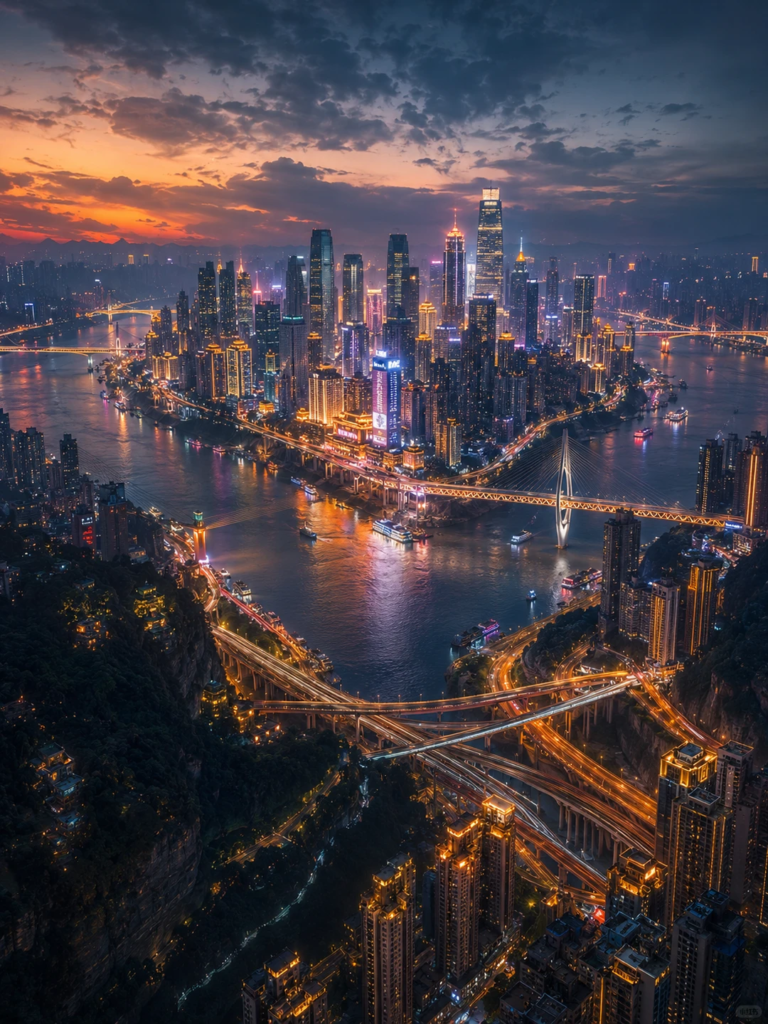
Chongqing is China’s ultimate hyper-city. It is a metropolis of 30 million people built not on a plain, but carved directly into the sheer cliffs of the Ba mountains. It is a place where a monorail does not merely pass through a station, but bores cleanly through the living room of a nineteen-story apartment building; where a local map is utterly useless because the “ground floor” you are standing on is actually the eleventh-story rooftop of another complex entirely; and where neon-lit sky-bridges span chasms between skyscrapers like walkways in a Blade Runner storyboard.
Yet, beneath this staggering, cyberpunk exterior lies an ancient, fiery, and deeply hedonistic soul. Chongqing is a city of intense sensory contrast. It is a place where a traveler can step out of a Maserati, walk down a subterranean flight of wet stone steps, and sit on a plastic stool to eat a violently spicy hotpot beneath a highway overpass—all while surrounded by the humid, cinematic fog that has defined the region for millennia.
For the luxury traveler who has grown weary of the sanitized, predictable hospitality of Western Europe or the uniform glitz of the Gulf States, Chongqing offers the ultimate premium: pure, unadulterated, architectural and cultural vertigo. This is a guide to navigating China’s most spectacular visual paradox in absolute comfort.
Part II: The Architecture of Illusion
To understand Chongqing, one must understand its topography. The city does not expand outward; it stacks upward. This verticality has birthed an architectural vernacular found nowhere else on earth.
The Monument of Liberation (Jiefangbei)
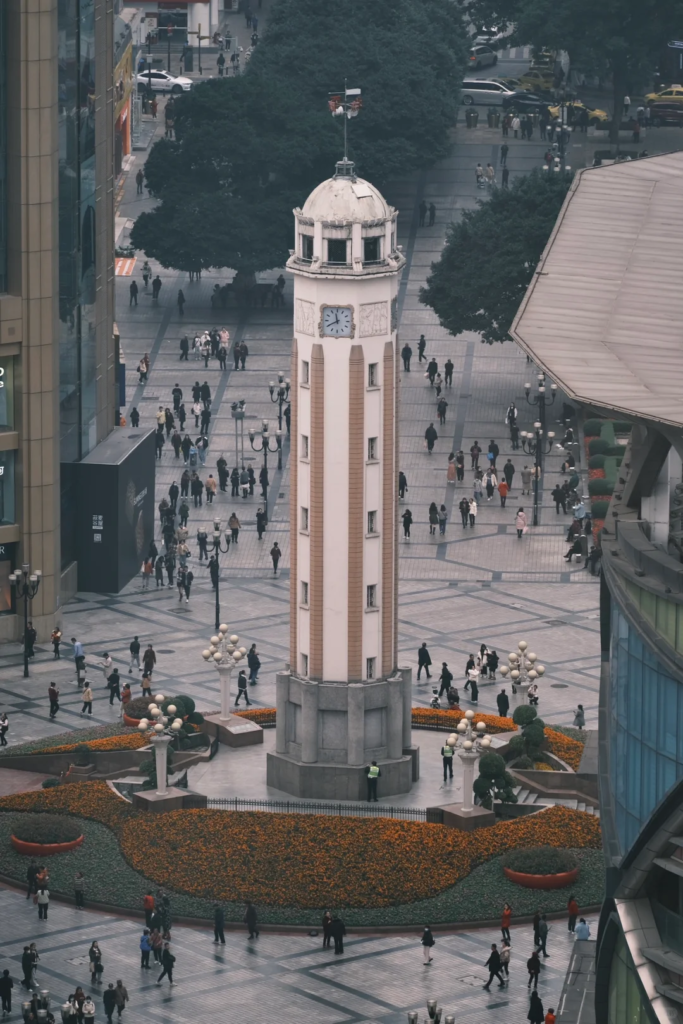
The spiritual and commercial heart of the city is Jiefangbei. Once the tallest structure in the area when built in 1947 to commemorate the victory over Axis powers, this modest clock tower is now dwarfed by a ring of hyper-futuristic supertalls. Walking through Jiefangbei feels like walking through a canyon of glass and LED screens. It is the Rodeo Drive of Western China, where global fashion houses—Chanel, Dior, Hermès—occupy multi-story flagship stores that glow like neon lanterns against the perpetual grey of the mountain sky.
Raffles City: The Cyber-Gulliver
Nowhere is this sci-fi ambition more evident than Raffles City Chongqing. Designed by the legendary architect Moshe Safdie, this $4.8 billion mega-structure sits at Chaotianmen, the historic prow of the city where the muddy brown waters of the Yangtze meet the clear green of the Jialing.
The complex consists of eight soaring towers, but its crowning glory is The Crystal—a 300-meter-long horizontal sky-bridge enclosed in glass and steel that rests atop four of the towers at a height of 250 meters. It is, effectively, a skyscraper laid on its side across the sky. Inside, you will find lush indoor gardens, a viewing deck with a transparent glass floor that will make your chest tighten, and an infinity pool that seems to spill directly into the clouds. At night, when the structure is illuminated by thousands of programmable LEDs, it looks like a colossal starship preparing to lift off from the riverbank.
Hongyadong: The Spirit Within the Shell
If Raffles City represents Chongqing’s future, Hongyadong is its mythological past reimagined for the digital age. Built directly into a cliffside facing the Jialing River, Hongyadong is an eleven-story complex constructed in the traditional Diaojiaolou (stilt house) style of the local Ba culture.
During the day, it is a fascinating, labyrinthine marketplace of spice vendors, artisans, and tea houses. But at twilight, the magic happens. The entire cliffside ignites with warm, golden lanterns, casting a surreal, cinematic glow over the river. Seen from across the Qiansimen Bridge, Hongyadong looks precisely like the bathhouse from Hayao Miyazaki’s animated masterpiece, Spirited Away, miraculously dropped into the center of a sci-fi mega-city.
A Note for the Discerning Lens: To capture Hongyadong without the suffocating crowds, eschew the public viewing platforms. Instead, have your concierge arrange a private riverboat charter or book a window table at one of the high-end lounges across the river on the Nanbin Road promenade.
Part III: The Luxury Havens
In a city defined by verticality, the best hotels don’t just offer rooms; they offer sovereignty over the skyline. The luxury hospitality scene in Chongqing has evolved into an arms race of high-altitude design.
The Regent Chongqing: An Oasis of Quiet Gravity
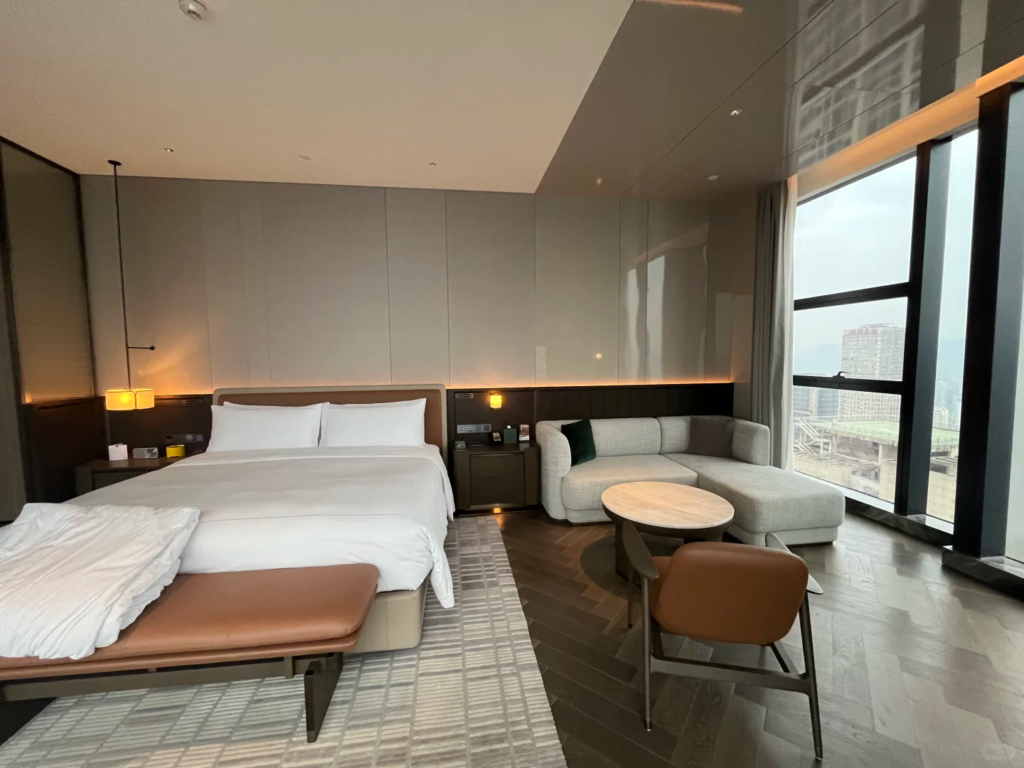
Located in the Jiangbeizui financial district, just across the river from Jiefangbei, The Regent Chongqing is a masterclass in understated luxury. While the city outside screams in neon, the Regent whispers in dark timber, brushed bronze, and deep crimson lacquer. Designed by the renowned hospitality firm LTW Designworks, the hotel pays homage to Chongqing’s industrial heritage—specifically its ironworks and weaving traditions—without ever feeling dated.
The rooms here are palatial, featuring floor-to-ceiling windows that look out across the Jialing River toward the glittering facade of Hongyadong. The true piece de résistance, however, is Bar Nyx. Located on the outdoor terrace, it offers an unobstructed, cinematic view of the city’s skyline. Here, wrapped in a plush cashmere blanket provided by the staff, one can sip a perfectly executed barrel-aged Negroni while watching the monorails glide silently across the distant bridges.
Niccolo Chongqing: Sky-High Elegance
For those who prefer their luxury with a sharp, sartorial edge, Niccolo Chongqing is the definitive choice. Occupying the top floors of the Chongqing IFS Tower 1 in Jiangbeizui, the Niccolo is the highest luxury hotel in the city center.
The experience begins the moment you step into the glass elevator, which rockets you to the 62nd-floor sky lobby in a matter of seconds. The aesthetic is unashamedly modern and fashion-forward: clean lines, neutral palettes accented by striking contemporary artwork, and a clientele that looks as though they have just stepped off a runway in Milan.
The hotel’s signature restaurant, The Niccolo Kitchen, and the adjacent Bar 62, are the glittering playgrounds of Chongqing’s young, affluent elite. To sit by the window at Bar 62 at midnight, with the clouds literally drifting past the glass and the city lights sparkling half a kilometer below, is to feel entirely disconnected from the mundane realities of the earth.
InterContinental Chongqing Raffles City: Inside the Starship
For the ultimate cyberpunk immersion, one must stay within the belly of the beast itself. The InterContinental Chongqing Raffles City is integrated directly into Moshe Safdie’s architectural marvel.
The hotel’s lobby is located within The Crystal skybridge, meaning guests check in amidst a soaring indoor forest suspended 250 meters in the air. The design language here is cinematic and futuristic, utilizing curved metallic surfaces and organic forms that echo the hull of a luxury spaceship. Request a Horizon Riverview Suite; the curvature of the glass walls offers a panoramic view of the Yangtze shipping lanes that is nothing short of hypnotic.
Part IV: The Gastronomy of Fire and Silk
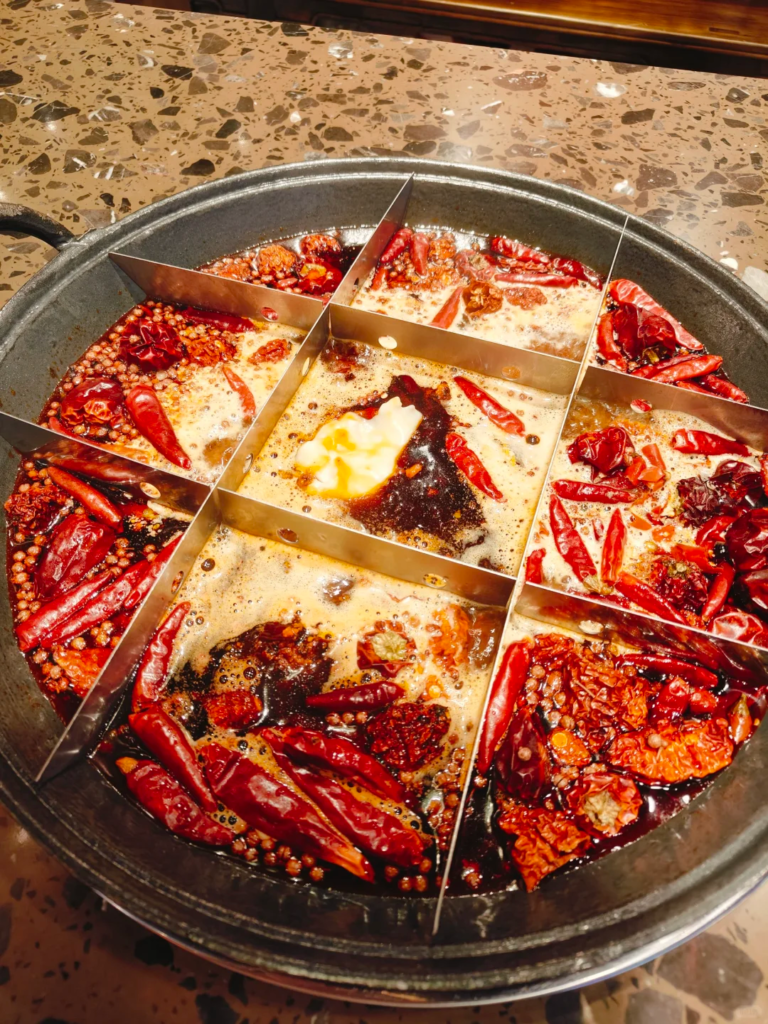
To experience Chongqing without surrendering to its culinary hedonism is an incomplete journey. This is a cuisine defined by Mala (麻辣)—a sensory double-helix of searing chili heat and the numbing, electric buzz of Sichuan peppercorns. It is brutalist gastronomy, and it is magnificent.