Tiananmen Square Beijing: Understanding the Symbolic Heart of China
Tiananmen Square Beijing: Understanding the Symbolic Heart of China
Tiananmen Square Beijing: Understanding the Symbolic Heart of China
Explore the History, Architecture, and Cultural Meaning Behind Beijing’s Most Famous Landmark
Introduction: Standing at the Center of Beijing’s Story
Imagine standing in the middle of a vast open square in the heart of one of the world’s oldest capitals.
Above you, the Chinese national flag rises slowly into the morning sky.
Around you are some of Beijing’s most important landmarks:
The Forbidden City stands directly to the north.
The National Museum of China stretches along the eastern side.
The Great Hall of the People stands on the western side.
In the center is a monument dedicated to the people who shaped China’s modern history.
This is Tiananmen Square.
For millions of visitors, Tiananmen Square is the first image that comes to mind when they think of Beijing.
It is one of the largest public squares in the world, but its importance goes far beyond its size.
Unlike a traditional palace or ancient temple, Tiananmen Square does not represent only one period of history.
It connects different eras of China:
- The imperial world of ancient dynasties
- The political changes of modern China
- The daily life of a city that continues to evolve
For centuries, this area has been at the center of Beijing’s story.
It has witnessed royal ceremonies, historical changes, and important national events.
Today, visitors come here not only to take photographs but also to understand a place that carries deep cultural meaning.
To truly appreciate Tiananmen Square, travelers need to look beyond the open space in front of them.
They need to discover the history, architecture, and ideas that made this place the symbolic heart of China.
Why Is Tiananmen Square the Center of Beijing?
The Ancient Logic Behind Beijing’s Urban Design
One of the most fascinating things about Beijing is that the city was carefully planned according to traditional Chinese ideas of order and harmony.
At the center of this design is Beijing’s famous north-south axis.
This central line connects many of the city’s most important landmarks:
- Yongding Gate in the south
- Tiananmen Square
- The Forbidden City
- Jingshan Park
- The Drum and Bell Towers in the north
This layout was not created by accident.
In traditional Chinese culture, the center represented balance, stability, and importance.
The emperor’s palace was placed at the center because the ruler was believed to stand between heaven and earth.
Tiananmen Square developed around this central area and became a place where the relationship between the city, the government, and the people could be seen.
When visitors stand in the square today, they are standing on a location that has shaped Beijing’s identity for hundreds of years.
The Story Behind Tiananmen Gate
The Gate That Gave the Square Its Name
Many international visitors use the names Tiananmen Square and Tiananmen Gate interchangeably, but they are actually different places.
Tiananmen means:
“Gate of Heavenly Peace.”
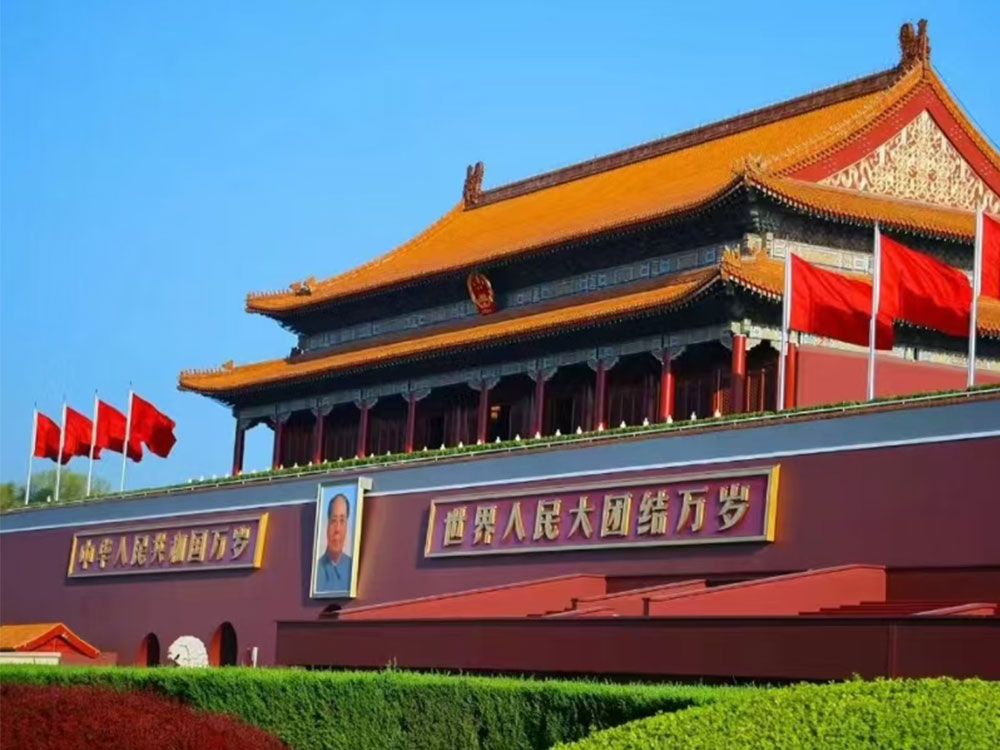
The gate itself is the famous red building located at the northern edge of the square, directly in front of the Forbidden City.
It was originally built during the Ming Dynasty in the 15th century.
At that time, it served as an important entrance to the imperial city.
The gate was not simply a doorway.
It represented the connection between the emperor and the outside world.
During the imperial era, important announcements and ceremonies were sometimes made from this location.
For ordinary people, passing through this gate was a rare and meaningful experience because the imperial city was a restricted area.
The gate symbolized the distance between the emperor’s world and everyday life.
From Imperial Entrance to National Symbol
How Tiananmen Changed With China’s History
For hundreds of years, Tiananmen was closely connected with imperial Beijing.
It was part of the world surrounding the Forbidden City.
However, as China entered the modern era, the meaning of this area changed.
The old imperial system ended, and Tiananmen gradually became a symbol connected with modern national identity.
The square was expanded during the 20th century and transformed into a large public space.
Unlike the imperial period, when important areas of Beijing were designed mainly around the emperor, the modern square was designed as a place representing the nation and the people.
This transformation reflects a major change in Chinese history:
The center of Beijing moved from an imperial palace to a national public space.
The Architecture of Tiananmen: Symbols Hidden in Design
More Than Just a Beautiful Building
For many visitors, the first impression of Tiananmen is its powerful visual appearance:
The large red walls.
The traditional roof.
The golden decorations.
The wide open space in front.
But every element carries meaning.
The Meaning of Red Walls
The color red has always been important in Chinese culture.
Traditionally, red represents:
- Celebration
- Prosperity
- Importance
- Protection
In imperial architecture, red walls were commonly used for important buildings.
The red walls of Tiananmen connect the site with Beijing’s long architectural tradition.
The Meaning of Golden Roofs
The golden roof is another important feature.
In traditional Chinese architecture, yellow was strongly associated with imperial authority.
During the Ming and Qing dynasties, yellow roof tiles were reserved mainly for important imperial buildings.
This is why visitors will notice many golden roofs throughout the Forbidden City area.
The design of Tiananmen reflects this historical connection.
Tiananmen and the Forbidden City: Two Connected Worlds
The Entrance to the Emperor’s World
One of the best ways to understand Tiananmen is to see its relationship with the Forbidden City.
The two places are directly connected.
During imperial times:
Tiananmen represented the entrance.
The Forbidden City represented the private world of the emperor.
Behind the walls of the Forbidden City were:
- Royal residences
- Government offices
- Ceremonial halls
- Imperial gardens
The emperor lived and worked inside this protected area.
Tiananmen stood as the important gateway between the imperial world and the outside city.
Today, visitors can walk through this same historical area and experience how Beijing was organized during the imperial era.
Tiananmen Square Through China’s Modern History
A Place Where History Happened
Tiananmen Square has played an important role in many moments of modern Chinese history.
Because of its central location and symbolic importance, it became a place where major public events took place.
One of the most famous moments was the founding ceremony of the People’s Republic of China in 1949.
Since then, the square has continued to be associated with important national celebrations and public events.
For Chinese people, Tiananmen represents a connection between the country’s past and present.
For international visitors, learning about its history provides a deeper understanding of modern China.
The Flag-Raising Ceremony: A Meaningful Beijing Experience
Starting the Day at the Heart of the Capital
One of the most popular experiences for visitors is watching the daily flag-raising ceremony at Tiananmen Square.
Every morning, people gather before sunrise to watch the national flag being raised.
Many visitors arrive early because the ceremony has become a meaningful part of a Beijing trip.
The experience is not only about watching a ceremony.
It is about feeling the atmosphere of a place that holds great importance for many people.
Standing among visitors, local residents, and travelers from different countries creates a unique moment.
It shows how one public space can connect people with history and national identity.
Exploring the Landmarks Around Tiananmen Square
A Walk Through China’s History
One of the advantages of visiting Tiananmen Square is that many important attractions are located nearby.
A visit here can easily become a journey through different periods of Chinese history.
The Forbidden City
Located directly north of Tiananmen Gate, the Forbidden City was the home of Chinese emperors for almost 500 years.
It represents:
- Imperial power
- Traditional architecture
- Royal life
Walking from Tiananmen into the Forbidden City allows visitors to follow the same route once used by emperors and officials.
The National Museum of China
Located on the eastern side of the square, the National Museum of China introduces visitors to thousands of years of Chinese history.
Its collections include:
- Ancient artworks
- Historical objects
- Cultural treasures
For travelers who want deeper historical knowledge, the museum provides valuable context.
The Great Hall of the People
Located on the western side, the Great Hall of the People is an important modern building.
Its architecture represents the development of modern China and continues the tradition of placing important structures around the central axis of Beijing.
The Monument to the People’s Heroes
Located in the center of the square, this monument honors people who contributed to China’s modern history.
Its location reflects the importance of remembering history and those who shaped the country.
Why International Travelers Should Visit Tiananmen Square
Understanding Beijing Beyond the Photos
Many travelers visit Tiananmen Square because it is famous.
But the real value of the experience comes from understanding its meaning.
The square allows visitors to see different layers of Beijing at the same time:
Ancient Beijing
Through its connection with the Forbidden City and imperial architecture.
Modern Beijing
Through its role as a symbol of contemporary China.
Cultural Beijing
Through the traditions, ceremonies, and stories connected with this place.
For travelers who want to understand China beyond sightseeing, Tiananmen Square offers an important introduction.
How to Experience Tiananmen Square Like a Cultural Traveler
Visit Early in the Morning
Morning is one of the best times to visit.
The atmosphere is calmer, and visitors can experience the flag-raising ceremony.
The soft morning light also creates beautiful views of the surrounding architecture.
Combine It With the Forbidden City
The best way to understand Tiananmen Square is to visit it together with the Forbidden City.
The two locations tell a connected story:
Tiananmen represents the entrance and public face of Beijing.
The Forbidden City represents the private imperial world behind the walls.
Look Beyond the Famous View
Many visitors take the famous photograph of Tiananmen Gate.
But try to notice more:
- The city layout
- The surrounding buildings
- The historical connection between different landmarks
The more you understand, the more meaningful the visit becomes.
Final Thoughts: Tiananmen Square Is More Than a Landmark
The Great Wall represents China’s determination.
The Forbidden City represents China’s imperial history.
The Temple of Heaven represents harmony between humans and nature.
But Tiananmen Square represents the changing story of China itself.
It connects ancient traditions with modern history.
It connects the imperial capital with the modern city.
It connects architecture, memory, and national identity.
Standing in Tiananmen Square, visitors are not simply standing in a large open space.
They are standing at the center of Beijing’s story.
A story that has continued for centuries and continues to be written today.